

SAP is a German software company and, at the same time, the name people use for its best-known product: SAP ERP, the enterprise resource planning system that many of the world’s largest companies use to run accounting, procurement, sales, manufacturing, warehousing and HR in a single application. When someone says “we run SAP”, they almost always mean that ERP, today in its SAP S/4HANA version.
This guide, written by a working SAP consultant, explains what SAP is, what SAP stands for, what SAP ERP is, what SAP software is used for in a company, its modules, the differences between SAP ECC and S/4HANA, the support deadlines everyone is talking about and what it is like to work with SAP.
What is SAP? A simple definition
SAP is enterprise resource planning (ERP) software that integrates all of a company’s processes in one system with one database. Instead of a separate program for accounting, another for the warehouse and another for sales, every department works on the same data in real time.
A quick example: when a sales rep enters a customer order in SAP, the system checks stock, reserves the goods, schedules the delivery, creates the invoice and automatically posts the accounting entry and the open receivable. Nobody re-keys data into another system. That integration is the main reason large companies choose SAP. For the general concept, see what is an ERP.
What does SAP stand for?
SAP stands for Systeme, Anwendungen und Produkte in der Datenverarbeitung, German for “Systems, Applications and Products in Data Processing”. According to SAP’s official history, the company’s original 1972 name was SystemAnalyse Programmentwicklung (System Analysis Program Development). It is pronounced letter by letter, “S-A-P”, not like tree sap.
SAP the company: key facts
| Founded | 1972 by five former IBM employees: Dietmar Hopp, Hasso Plattner, Claus Wellenreuther, Klaus Tschira and Hans-Werner Hector |
| Headquarters | Walldorf, Germany |
| Employees | 110,000+ from 157+ countries |
| Revenue | €36.8 billion total revenue in FY2025 (non-IFRS) |
| Cloud users | 300 million+ subscribers |
| Flagship product | SAP S/4HANA (ERP) |
What is SAP ERP?
SAP ERP is SAP’s enterprise resource planning system. It has gone through several generations, which is useful to know when reading job ads or project documents:
| Year | Release | What it brought |
|---|---|---|
| 1975 | R/1 | First applications for financial accounting, invoice verification and inventory |
| 1979 | R/2 | Mainframe software and SAP’s first big commercial success |
| 1992 | R/3 | Client-server architecture and SAP GUI; made SAP a global leader |
| 2000s | mySAP ERP / SAP ECC 6.0 | R/3 successor on NetWeaver; still widely used |
| 2011 | SAP HANA | In-memory database for real-time analytics |
| 2015 | SAP S/4HANA | Next-generation ERP running only on SAP HANA, with Fiori and a simplified data model |
So “SAP ERP” can mean either the product SAP ERP 6.0 (also called SAP ECC) or, generically, any SAP ERP including S/4HANA.
What is SAP used for?
SAP software is used to run business processes end to end. The four big cycles you will find in almost every implementation are:
- Procure to pay: purchase requisition, purchase order, goods receipt, vendor invoice and payment.
- Order to cash: quotation, sales order, delivery, billing and collection.
- Plan to produce: material requirements planning, production orders, consumption and costing.
- Record to report: accounting, treasury, fixed assets, tax and financial close.
What companies get: a single source of truth for every department, real-time information, standardized processes based on best practices, legal compliance in dozens of countries (tax, bank formats, accounting standards) and full audit trail. The downsides: high license and implementation costs, long projects, the need for specialist consultants and training, and harder upgrades when the system is heavily customized.
SAP modules
SAP ERP is organized into modules, one per business area. The full list with T-codes is in our SAP modules list.
| Module | Area | Typical processes |
|---|---|---|
| FI | Financial Accounting | General ledger, payables, receivables, banks, assets, tax |
| CO | Controlling | Cost centers, internal orders, profitability |
| MM | Materials Management | Purchasing, inventory, invoice verification |
| SD | Sales and Distribution | Sales orders, pricing, deliveries, billing |
| PP | Production Planning | MRP, bills of material, production orders |
| QM / PM / PS | Quality / maintenance / projects | Inspections, maintenance orders, WBS projects |
| HCM | Human Capital Management | Employees, time, payroll (cloud: SuccessFactors) |
Finance is the one module every SAP customer runs; learn how it works in what is SAP FI.
What is SAP S/4HANA and how is it different from SAP ECC?
SAP S/4HANA is the current generation of SAP’s ERP. “S/4” stands for Suite 4 (the fourth generation after R/1, R/2 and R/3) and “HANA” is the in-memory database it runs on exclusively.
| Topic | SAP ECC 6.0 | SAP S/4HANA |
|---|---|---|
| Database | Any supported (Oracle, SQL Server, DB2, HANA…) | SAP HANA only |
| User interface | SAP GUI | SAP Fiori (web) plus SAP GUI |
| Data model | Redundant totals and index tables | Simplified: ACDOCA for finance, MATDOC for inventory |
| Customers and vendors | Separate master data | Single Business Partner |
| Deployment | On premise | On premise, Cloud Private Edition or Cloud Public Edition |
| AI and analytics | Batch reports | Real-time analytics and the Joule AI copilot |
| Support | Mainstream maintenance until end of 2027 | SAP’s strategic ERP |
SAP ECC end of support: 2027, 2030 and 2033
- End of 2027: mainstream maintenance ends for SAP Business Suite 7, which includes SAP ERP 6.0 / ECC.
- End of 2030: optional extended maintenance ends (at extra cost).
- 2031–2033: large, complex customers can use the SAP ERP, private edition, transition option, provided they move to that edition on SAP HANA before 31 December 2030 and subscribe to the required success plan (SAP News; The Register).
These dates explain the wave of S/4HANA migrations and the strong demand for SAP consultants. If you are on a migration project, see our guide to SAP Migration Cockpit.
SAP in the cloud: RISE with SAP and GROW with SAP
SAP now sells its ERP mainly as a cloud subscription. RISE with SAP targets large enterprises (typically S/4HANA Cloud Private Edition with infrastructure, support and tools bundled), while GROW with SAP targets midsize companies starting on the more standardized S/4HANA Cloud Public Edition. Small businesses have a different product, SAP Business One.
Other SAP products besides the ERP
- SAP SuccessFactors: cloud HR (time off, performance, payroll). See our SuccessFactors login guide.
- SAP Ariba: procurement and supplier portal. See SAP Ariba supplier login.
- SAP Concur: travel and expenses. See how to submit a Concur expense report.
- SAP Business Technology Platform (BTP): integrate, extend and build apps on SAP.
- SAP Analytics Cloud and SAP Business Data Cloud: analytics, planning and data.
How people work in SAP: SAP GUI, Fiori and T-codes
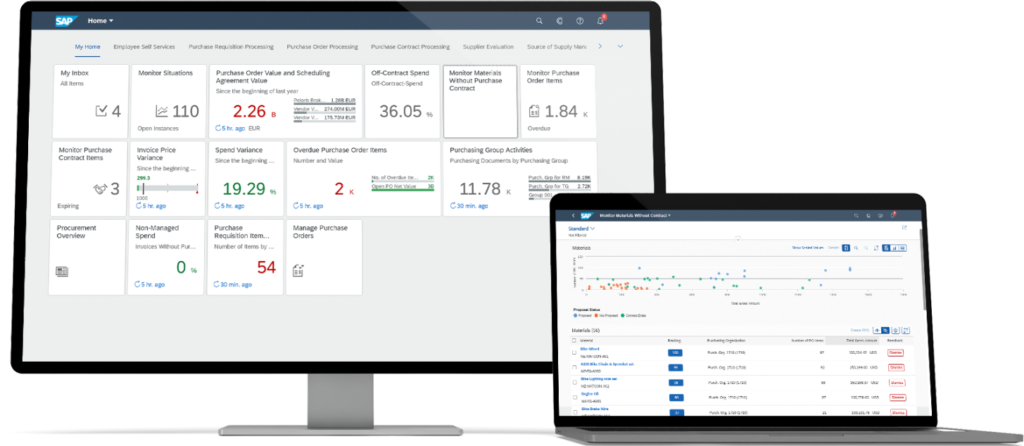
There are two ways into SAP. The classic one is SAP GUI, a Windows client (the current release is SAP GUI 8.10) where you work with transaction codes such as FB50 (G/L posting), ME21N (purchase order) or VA01 (sales order). The modern one is SAP Fiori, a web launchpad of app tiles that runs in the browser, on tablets and on phones.
Data lives in tables (for example BKPF for accounting documents or KNA1 for customers) that consultants read with SE16N or SE16H. Two cheat sheets for beginners: SAP transaction codes list and SAP tables list.
Who uses SAP?
SAP is the reference ERP for large enterprises and multinationals in almost every industry: manufacturing, automotive, energy, chemicals, pharma, consumer goods, retail, telecoms, banking and the public sector. Many midsize companies also use it through S/4HANA Cloud Public Edition. If you work for a Fortune 500 or FTSE 100 company, your finance team very likely runs SAP.
Working with SAP: roles
- Key user: accountants, buyers or sales staff who use SAP every day and know their process in depth.
- Functional consultant: designs and configures a module (FI, CO, MM, SD…). Read what an SAP consultant does.
- ABAP developer: builds reports, interfaces and enhancements.
- Basis administrator: installs, upgrades and maintains the system.
SAP FAQ
Is SAP a software or a company?
Both. SAP SE is the German company, and “SAP” is also used for its ERP software (SAP ECC or SAP S/4HANA).
What is the difference between SAP and SAP ERP?
SAP is the company and brand; SAP ERP is its business management system. Strictly speaking, SAP ERP 6.0 (ECC) is the product that preceded S/4HANA.
Is SAP hard to learn?
As an end user, a few weeks is enough if you know your business process. As a consultant, you need to master a module and its configuration, which takes months of training and years of project work.
How much does SAP cost?
SAP does not publish ERP list prices for large enterprises; cost depends on users, scope and model (cloud subscription or license), plus implementation, which often costs as much as the software. SAP Business One is the more affordable option for small businesses.
Is SAP still the ERP market leader?
SAP is Europe’s largest software company and one of the most widely deployed ERP vendors among large enterprises, alongside Oracle and Microsoft Dynamics.